Eisenhower Matrix: How to Prioritize Tasks (With Examples)
Apply the Eisenhower Matrix to prioritize tasks, with practical examples of what to do, schedule, delegate, or drop. Plus MoSCoW, RICE, and 80/20.
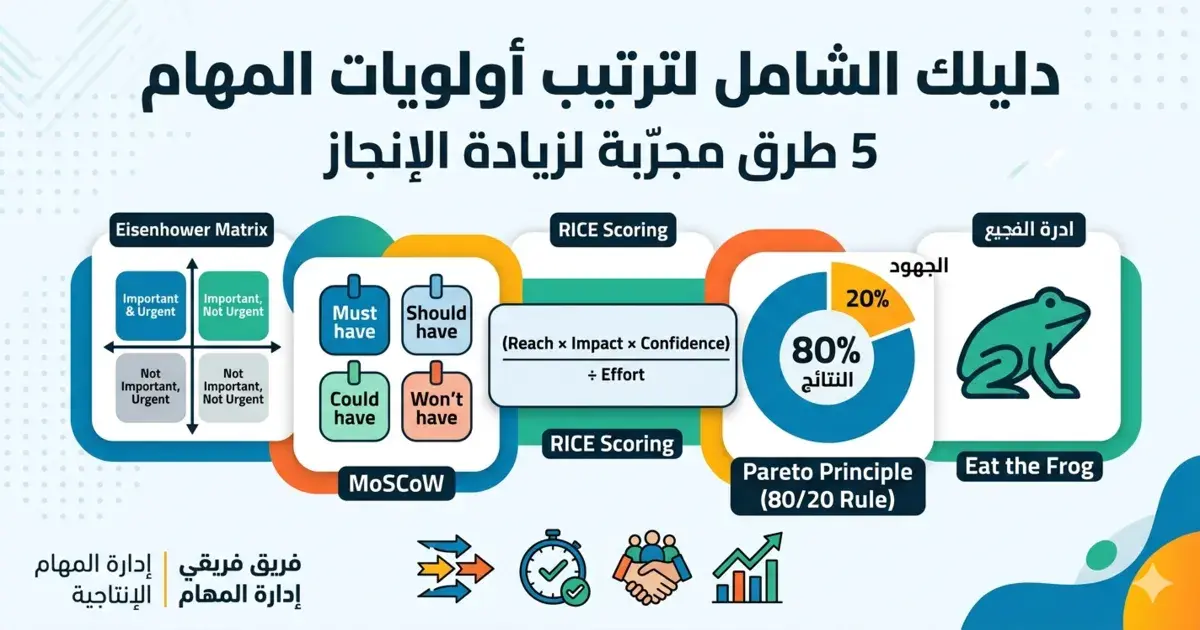
You have 30 tasks and only 8 hours. What do you tackle first?
How many times have you started your day feeling motivated, opened your task list, and found everything marked "urgent"? So you begin working on whatever catches your eye first. You reply to an email here, attend a meeting there, fix a document that was due yesterday.. and by the end of the day, you feel like you worked for 10 hours but didn't actually move the needle on anything that matters.
The problem isn't that you're lazy or disorganized. The problem is that you're treating every task the same way. That's where task prioritization comes in, not as a textbook idea, but as a daily skill you use at work.
In this guide, we'll walk through 5 proven methods for prioritizing tasks, complete with real-world examples and actionable steps you can start using tomorrow. If you want the bigger picture on organizing your team's work, check out our complete guide to project management.
1. The Eisenhower Matrix, The Most Popular Prioritization Framework
What is it?
U.S. President Dwight Eisenhower once said: "What is important is seldom urgent, and what is urgent is seldom important." From this insight came the Eisenhower Matrix, a simple tool that sorts your tasks into 4 quadrants based on two questions: Is the task important? And is it urgent?
The Four Quadrants
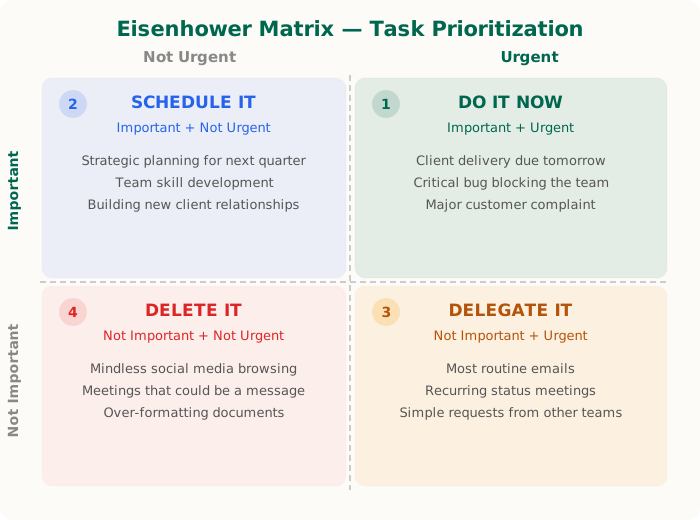
Quadrant 1: Important and Urgent, Do it now These are the tasks that, if left undone today, will cause real problems. Examples:
- A client deliverable due tomorrow
- A technical issue that has blocked the entire team
- Responding to a major customer complaint
Quadrant 2: Important but Not Urgent, Schedule it This is the real secret to productivity. These tasks don't have immediate time pressure, but they're the ones that build your future. Examples:
- Developing your team's skills and training them
- Planning for the next three months
- Building relationships with new clients
- Improving how the team works together
The mistake we all make? We postpone these tasks until they become Quadrant 1, they become urgent and important, and we end up tackling them under pressure. The fix: block dedicated time on your calendar so they don't slip through the cracks.
Quadrant 3: Urgent but Not Important, Delegate it These tasks feel like they need to happen right now, but if you stop and think about it, they don't actually help you reach your bigger goals. Examples:
- Most emails and messages that need a quick reply
- Routine status meetings that could be a written update
- Simple requests from other departments
The solution? Delegate them to someone else on the team. This is where task management helps you distribute work clearly, everyone knows exactly what they're responsible for.
Quadrant 4: Neither Important nor Urgent, Eliminate it These things steal your time without you even realizing it. Examples:
- Scrolling social media with no purpose
- Unnecessary meetings that could have been a message
- Over-formatting documents beyond what's needed
Be honest with yourself. If a task doesn't serve your goals and doesn't have a real deadline, delete it.
When should you use the Eisenhower Matrix?
This method is excellent for daily use. Every morning, take 5 minutes to sort your tasks into the four quadrants. You'll notice that most of your tasks land in Quadrants 2 and 3, and that realization alone will change how you approach your entire day.
2. The MoSCoW Method, When Your Team Needs to Agree on What Matters Most
What is it?
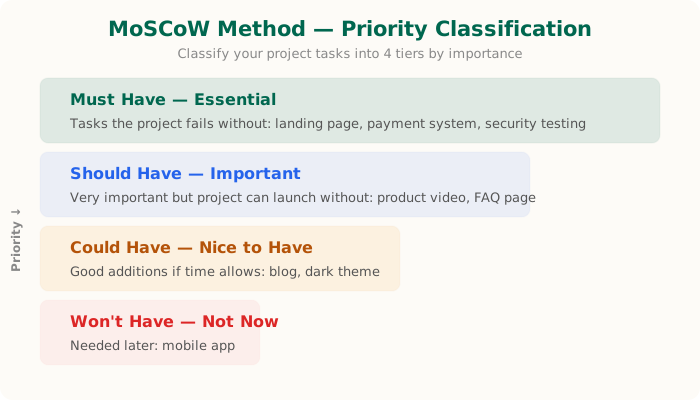
MoSCoW is an acronym for four categories:
- Must have: Tasks without which the project fails entirely
- Should have: Very important, but the project can ship without them temporarily
- Could have: Nice-to-have additions if time allows
- Won't have: We know they're needed, but not in this phase
A Practical Example
Imagine your team is preparing to launch a new product next month:
- Must have: Landing page ready, payment system functional, security testing complete
- Should have: Product demo video, FAQ page
- Could have: Blog posts in both Arabic and English, dark theme
- Won't have: Mobile app (first release is web-only)
When should you use it?
MoSCoW works best when planning work cycles and setting project boundaries. When you sit down with your team and classify tasks together, everyone leaves the meeting understanding exactly what the priorities are. Use discussions so the team can share their input on how each task should be classified: it's not just the manager deciding.
3. RICE Scoring, When You Need Numbers, Not Gut Feelings
What is it?
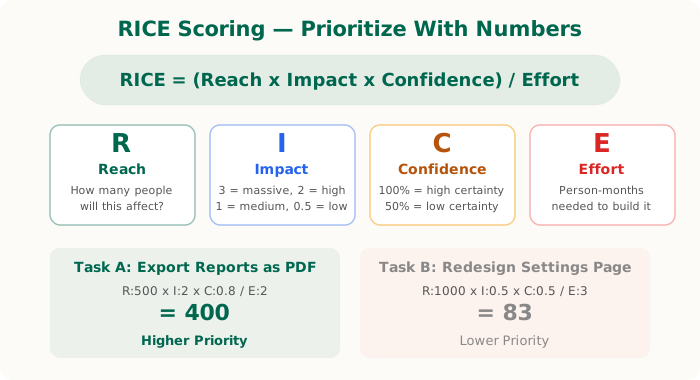
RICE is a number-based scoring system built by the team at Intercom. Instead of saying "I feel like this task is more important," you give each task a score based on 4 things:
- Reach: How many people will benefit from this task?
- Impact: How much will each person be affected? (3 = a lot, 2 = quite a bit, 1 = some, 0.5 = a little, 0.25 = barely)
- Confidence: How sure are you about these numbers? (100% = very sure, 80% = fairly sure, 50% = not sure)
- Effort: How much time and how many people does it take to build?
The Formula
RICE Score = (Reach x Impact x Confidence) / Effort
A Worked Example
Let's say you have two tasks and need to decide which one comes first:
Task A: Add PDF export for reports
- Reach: 500 users per month
- Impact: 2 (high)
- Confidence: 80%
- Effort: 2 person-months
- RICE = (500 x 2 x 0.8) / 2 = 400
Task B: Redesign the settings page
- Reach: 1,000 users per month
- Impact: 0.5 (low)
- Confidence: 50%
- Effort: 3 person-months
- RICE = (1,000 x 0.5 x 0.5) / 3 = 83
The result? Task A wins by a wide margin (400 vs. 83), even though Task B reaches more users. The numbers show that the real benefit is much bigger with Task A.
When should you use it?
RICE is ideal for product teams with a long list of things to build who need to decide what to start first. Use reports to gather the data you need for calculating Reach and Impact accurately, instead of guessing.
4. The 80/20 Rule (Pareto Principle), Focus on What Actually Moves the Needle
What is it?
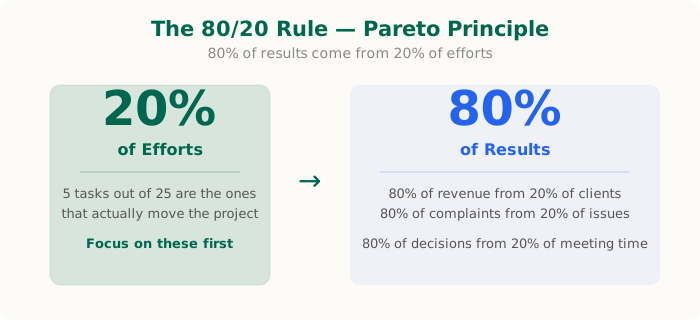
Italian economist Vilfredo Pareto observed that 80% of the land in Italy was owned by 20% of the population. This turned into a simple rule: in most cases, 80% of results come from 20% of efforts.
How to Apply It at Work
In sales: 80% of revenue comes from 20% of clients. Instead of spreading your effort across 100 clients, focus on the 20 who actually drive your numbers.
In task management: Out of a list of 25 tasks, roughly 5 tasks are the ones that will actually move the project forward. The remaining 20 tasks matter, but not with the same impact.
In problem-solving: 80% of customer complaints typically come from 20% of the issues. Fix those few issues, and most complaints disappear.
In meetings: 80% of useful decisions come from 20% of meeting time. That should make you think: do you really need a one-hour meeting, or would a focused 15 minutes be enough?
How to Apply It Practically
Every week, review your tasks and ask yourself: "If I could only accomplish 3 things this week, what would they be?" That question forces you to think about what truly makes a difference. Use the dashboard to see at a glance where your team's time is going, and whether it's actually going toward the 20% that matters.
5. Eat the Frog, Start With the Hardest Thing
What is it?
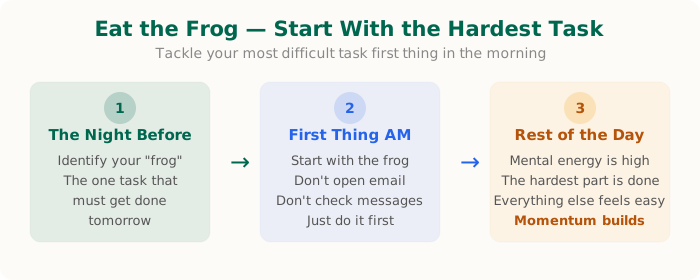
Mark Twain reportedly said: "If the first thing you do each morning is eat a live frog, the rest of your day will be easier because the worst is already behind you." The idea is simple: start your day with the hardest or least appealing task on your list.
Why Does It Work?
- Your energy is at its highest in the morning. As the day goes on, it gets harder to think through tough tasks
- It eliminates dread. The task you keep postponing weighs on you all day. When you knock it out first, you feel an enormous sense of relief
- It builds momentum. After completing the hard thing, every other task on your list feels easy by comparison
A Practical Example
You have a quarterly report you need to write (the frog) and 15 emails that need replies. Most people start with the emails because they're "quick." But after an hour of emails, your energy has dropped and the report feels even harder. Eat the frog first.
A Practical Tip
Identify your "frog" the night before. Before you go to sleep, write down the one task you must start with tomorrow. When you wake up, dive straight into it, before checking email or messages. Turn on notifications so that if something truly urgent comes up, it reaches you, without needing to monitor everything yourself.
How to Choose the Right Method
| Method | Best for | Team size | Frequency |
|---|---|---|---|
| Eisenhower Matrix | Sorting daily tasks | Individuals and small teams | Daily |
| MoSCoW | Setting project boundaries and work cycles | Medium and large teams | Every work cycle |
| RICE Scoring | Prioritizing product features | Product teams | Every 3 months |
| 80/20 Rule | Focusing on highest impact | Any size | Weekly |
| Eat the Frog | Overcoming procrastination | Individuals | Daily |
Here's the truth: you don't have to pick just one method. The most successful teams use a mix, the Eisenhower Matrix for daily sorting, MoSCoW for planning work cycles, and RICE for big product decisions.
The Ideal Daily Routine for Prioritization
Morning, Review and Focus (10 minutes)
- Open your task list and review what's on your plate today
- Classify tasks using the Eisenhower Matrix
- Identify your "frog", the most important task to tackle first
- Make sure you have only 3-5 core tasks for the day. More than that means nothing gets done properly
Midday, Quick Check-in (5 minutes)
- Did you eat the frog? If not, what blocked you?
- Has anything urgent come up that requires adjusting the plan?
- Do you need to communicate with someone on the team about something that's stuck?
End of Day, Evaluate and Plan (10 minutes)
- Review what got done and what didn't
- The tasks that didn't get done, are they actually important? If yes, move them to tomorrow
- Identify tomorrow's frog, the one task that must get done
- Open reports and review your team's overall progress
This simple routine, 25 minutes of your day, will transform your productivity in ways you won't expect.
If your tasks live in Fareeqy, your morning review can begin with one sentence. Fareeqy Assistant reads your list and suggests what deserves your attention first.
5 Common Prioritization Mistakes (and How to Avoid Them)
Mistake 1: Everything is "urgent"
When everything is urgent, nothing is truly urgent. If every task on your list carries an "urgent" label, it means you don't have a prioritization system, you have a chaotic list. The fix: use the Eisenhower Matrix and be ruthless. Truly urgent tasks shouldn't exceed 2-3 per day.
Mistake 2: Priorities without deadlines
You mark a task as high priority but don't set a due date? That task will stay "high priority" for weeks without moving. Every task needs a clear due date on your calendar.
Mistake 3: Priorities without reviews
You set your priorities at the start of the week and don't touch them until the week is over. The problem? Priorities shift daily. A client submits a new request, a technical issue surfaces, a team member calls in sick. You need to review your priorities every day.
Mistake 4: Deciding alone
The manager sets the team's priorities without asking anyone. The result? The team doesn't feel ownership and ends up working on tasks they're not convinced are the most important. Make prioritization a collaborative process.
Mistake 5: Ignoring the important for the urgent
This is the most dangerous mistake. You spend your entire day fighting fires (Quadrant 1) and never touch the long-term important tasks (Quadrant 2). The result? Every week brings new fires because you never spent time preventing problems before they happen. Dedicate at least 30% of your time to Quadrant 2.
Prioritization Isn't Just a List: It's a Mindset
Task prioritization isn't something you do once and forget about. It's a daily habit you build over time. Start with one method, the Eisenhower Matrix is the easiest starting point, and practice it for two weeks. Then try adding the 80/20 Rule to your weekly review. Over time, you'll find the combination that works best for you and your team.
The difference between a team that delivers and a team stuck in an endless loop? It's not the number of hours worked. It's how they prioritize. In Fareeqy, every task has one owner, one deadline, and one priority set by its place in the list, so the whole team can see the order of the work. If you want to learn more about choosing the right tool for your team, check out our comparison of Fareeqy with other project management tools.
Start simple. Start today. And watch how your team's productivity changes when everyone knows exactly what needs to get done first.