Time Management in Islam: Lessons from the Prophet's Life
How did Prophet Muhammad ﷺ organize the greatest project in history? Practical lessons from the Quran and Sunnah on time management, task organization, and excellence.
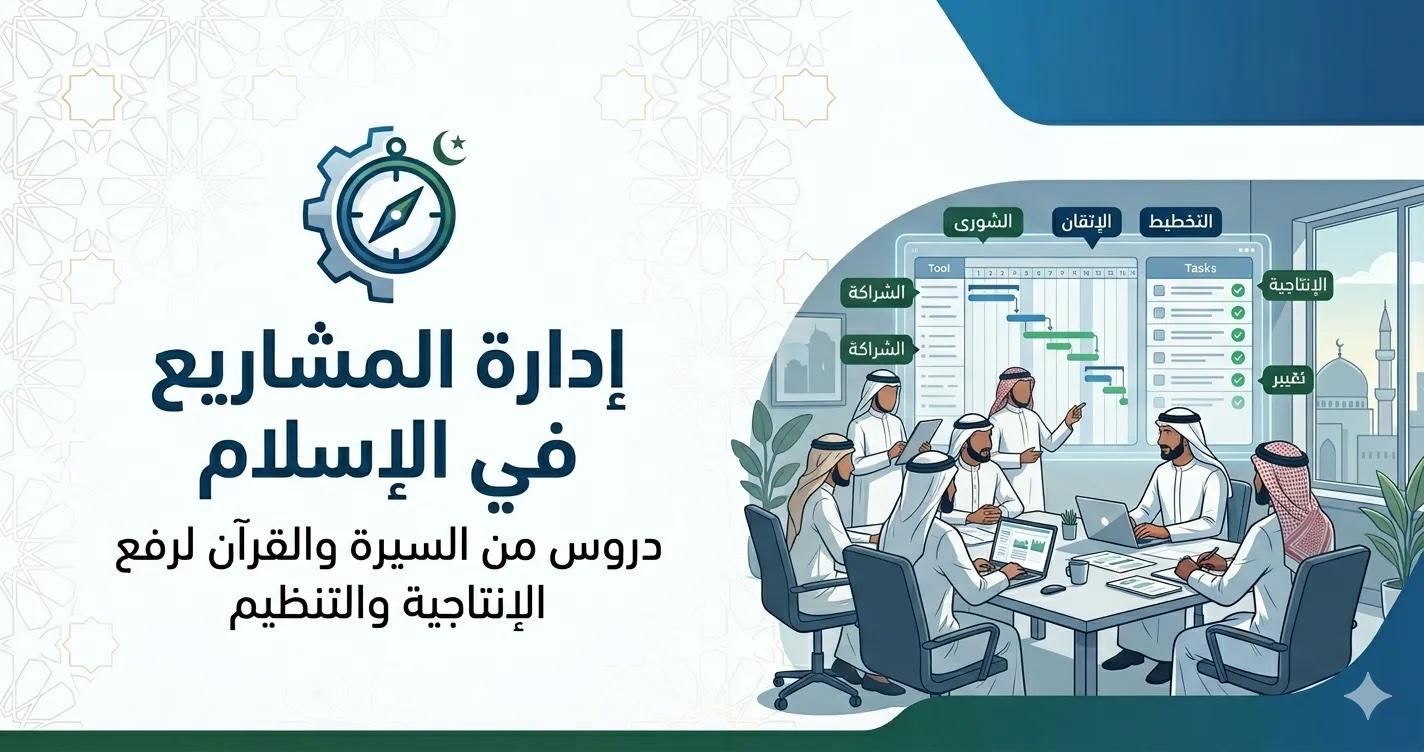
The Prophet ﷺ Managed the Greatest Project in History, Without a Single Tool
Think about it for a moment.
Prophet Muhammad ﷺ, in just 23 years, built a nation from scratch. He united warring tribes, established a state, organized armies, built an economy, drafted a constitution (the Charter of Medina), and sent ambassadors to the kings of the world. All while raising an entire generation and teaching them a new way of life.
If we measured these achievements by modern project management standards, team size, parallel projects, crisis management, strategic planning: we are talking about a level no CEO in history has reached.
The best part? The principles he ﷺ used are not theoretical concepts from management textbooks. They are Quranic and Prophetic teachings you can apply today to your work, your projects, and your team. Let us see how.
Time in Islam: Your Most Valuable Resource
God Swears by Time, Reflect on Surah Al-Asr
Allah Almighty swears by time in the opening verse of Surah Al-Asr:
"By time. Indeed, mankind is in loss. Except for those who have believed and done righteous deeds and advised each other to truth and advised each other to patience." , Surah Al-Asr (103: 1-3)
A surah of just 3 verses. Imam Al-Shafi'i, may God have mercy on him, said: "If God had revealed no other proof to His creation except this surah, it would have been sufficient for them."
Notice that the surah does not just say "believe." It says "believed AND done righteous deeds AND advised each other to truth AND advised each other to patience." Four conditions to escape loss: faith + productive action + mutual counsel + patience. Islam does not separate faith from productivity: they are one and the same.
"Seize Five Before Five"
The Prophet ﷺ laid down a time management rule that no consulting firm could summarize better:
"Take advantage of five before five: your youth before your old age, your health before your sickness, your wealth before your poverty, your free time before your busyness, and your life before your death." , Narrated by Al-Hakim in Al-Mustadrak
Five opportunities with expiration dates. You cannot postpone them. This is exactly the philosophy behind task prioritization, not everything deserves your time right now, but some things, if you do not do them today, the window closes.
"Your free time before your busyness." That phrase alone deserves deep reflection. How often do you have free time and waste it, then become busy and wish you had invested that time?
Itqan: Excellence in Every Task
The Concept of Itqan in Work
One of the most famous hadith in Islamic work culture:
"Indeed, Allah loves that when one of you does a task, they do it with itqan (excellence/perfection)." , Narrated by Al-Bayhaqi in Shu'ab al-Iman
Itqan in Islam is not just "getting the work done." Itqan means doing the work to the best of your ability, even if no one is watching. Even if no one will hold you accountable for it.
This is exactly the difference between a team that delivers and a team that just "gets through." The first delivers work they are proud of. The second delivers work that gets them past the moment.
Practical Application: How to Achieve Itqan in Your Projects
Itqan requires a system. You cannot perfect your work when your tasks are scattered between WhatsApp messages, notes on paper, and random emails.
Step one: every task needs a clear owner, a specific deadline, and a priority level. When every person on the team knows exactly what is expected of them, tasks get completed with excellence, not in a rush.
Step two: review your work before you deliver it. The Prophet ﷺ was deliberate in everything. He never rushed. Reviewing work before submission is a form of itqan.
Shura: Consultation in Decision-Making
The Quran Commands Consultation
Allah Almighty made consultation a fundamental characteristic of believers:
"And those who have responded to their Lord and established prayer and whose affair is consultation among themselves, and from what We have provided them, they spend." , Surah Ash-Shura (42: 38)
Notice that shura is mentioned between prayer and charity, meaning it holds the same level of importance in a Muslim's life.
The Prophet ﷺ applied this principle practically. In the Battle of Badr, he consulted his companions about the campsite. Al-Hubab ibn al-Mundhir (may God be pleased with him) suggested a strategically better location, and the Prophet ﷺ accepted his opinion immediately. He did not say "I am the leader and I decide." He accepted the better idea regardless of who suggested it.
In the Battle of the Trench, Salman al-Farisi (may God be pleased with him) suggested digging a trench, an idea unfamiliar to the Arabs. The Prophet ﷺ adopted it immediately. An idea from someone new to the community, but it was the right idea.
How to Apply Shura in Your Team
Many managers make all decisions alone and then inform the team. This approach kills creativity and makes the team feel like mere executors.
Shura means asking your team before you decide. Not on every small decision, but on decisions that affect everyone. Where do we focus this quarter? How do we distribute tasks? What is the priority?
Most importantly: when you ask, you must genuinely be willing to accept an opinion different from yours. Just as the Prophet ﷺ did with Al-Hubab and Salman. Shura without willingness to change is just formality.
Shura needs a stable place that gathers the discussion, not messages scattered across ten apps. The project Majlis in Fareeqy is built for exactly this: every project gets its own majlis where you raise the topic, every member weighs in with documented messages, and you pin the final decision so it stays a reference for anyone who opens the project months later. The name itself carries the meaning. For smaller discussions tied to a specific task, comments stay in their place on the task itself.
Planning: "Let Every Soul Look to What It Has Put Forth for Tomorrow"
The Quran Commands Looking Ahead
"O you who have believed, fear Allah. And let every soul look to what it has put forth for tomorrow." , Surah Al-Hashr (59: 18)
"Let every soul look to what it has put forth for tomorrow." This is the clearest verse about future planning. Not just for the Hereafter, for this life too. What have you prepared for tomorrow? What is your plan for next week? Next month?
The Prophet ﷺ was a first-class planner. The Hijrah plan from Mecca to Medina, which we celebrate every year, was meticulously planned by every standard:
- Precise timing, when the enemies were least vigilant
- Unconventional route, went south then north instead of the direct path
- Clear role distribution, Ali sleeps in his bed, Abu Bakr accompanies him, Abdullah ibn Abi Bakr brings intelligence, Amir ibn Fuhayra erases tracks, and Abdullah ibn Urayqit (a non-Muslim) serves as guide because he knew the terrain
- Pre-prepared resources, provisions and two camels were arranged in advance
Every person knew their exact role. No ambiguity, no improvisation. This is project planning in every sense of the word.
Accountability: "Each of You Is a Shepherd"
Every Person Is Responsible
One of the clearest hadith on defining responsibilities:
"Each of you is a shepherd and each of you is responsible for his flock. The leader is a shepherd and responsible for his flock, and the man is a shepherd in his family and responsible for his flock..." , Agreed upon (Bukhari and Muslim)
This hadith establishes a fundamental principle in team management: every person has a clear scope of responsibility. Not "everyone is responsible for everything", because when everyone is responsible, no one truly is.
In your team, every task needs one person responsible. Not a committee. Not "the team." One person whose name is clear, who is accountable for the result. And every project needs defined roles and permissions, who sees what, who edits what, who decides what.
Honestly, this principle alone, if applied properly, would solve half the problems of any team. If "who is responsible for this?" is a question that comes up often, you have a responsibility distribution problem.
Tawakkul With Taking Action
Tie Your Camel, Then Trust in God
One of the most famous Prophetic incidents on this topic: a man asked the Prophet ﷺ about his camel, should he tie it or trust in God?
"Tie it and trust in God." , Narrated by Al-Tirmidhi
Two words containing an entire philosophy: do your part first (take action), then trust God with the outcome.
At work, this means: plan your project to the best of your ability. Distribute tasks. Set deadlines. Track progress. But do not consume yourself with anxiety over results. Do your work with excellence and trust God with the outcome.
This balance is critically important, especially for entrepreneurs and managers carrying heavy pressure. Do what is in your control, and what you cannot control, leave it to God.
Delegation: How the Prophet ﷺ Distributed Responsibilities
The Prophet ﷺ did not do everything himself. He delegated with trust:
- Sent Muadh ibn Jabal as judge and teacher to Yemen, gave him broad authority in judiciary and education
- Appointed Attab ibn Asid as governor of Mecca, at just 20 years old
- Entrusted army leadership to youth like Usama ibn Zayd, at 18 years old
Notice: he did not only delegate small tasks. He delegated enormous responsibilities to people he trusted, even if they were young.
Delegation in Islam is not "getting rid of work." Delegation means trusting your team and giving them space to work. A manager who wants to review everything personally is not managing, he is suffocating his team.
Collaboration: "Cooperate in Righteousness and Piety"
"And cooperate in righteousness and piety, but do not cooperate in sin and aggression." , Surah Al-Ma'idah (5: 2)
Cooperation in Islam is not optional: it is a divine command. The Prophet ﷺ embodied this practically. During the construction of the Prophet's Mosque, he personally carried stones with his companions. He did not sit giving orders from afar, he went into the field and worked alongside the team.
During the digging of the trench, he was carrying dirt with everyone. The companions were chanting poetry as they dug and the Prophet ﷺ was with them. A leader who works alongside his team builds loyalty that no salary can buy.
In your team, collaboration needs tools that facilitate it. When discussions are tied to tasks directly, not scattered between WhatsApp, email, and Slack, the team collaborates more effectively.
Work and Worship: "When You Have Finished, Then Strive"
"So when you have finished [your duties], then stand up [for worship]. And to your Lord direct [your] longing." , Surah Ash-Sharh (94: 7-8)
"When you have finished, then strive", meaning when you complete one task, start another. No wasted time. But notice the next verse: "And to your Lord direct your longing", meaning all this effort should be directed toward God.
Islam does not tell you to work 16 hours a day. Islam tells you to work with excellence and balance. The Prophet ﷺ told Abdullah ibn Amr (may God be pleased with them both) when he was fasting every day and praying all night: "Indeed, your body has a right over you, your eyes have a right over you, and your wife has a right over you." (Agreed upon)
Your body has rights. Your eyes have rights. Your family has rights. Balance is not weakness, balance is the Sunnah.
Self-Accountability: "Hold Yourselves Accountable Before You Are Held Accountable"
Umar ibn al-Khattab (may God be pleased with him) said: "Hold yourselves accountable before you are held accountable, and weigh your deeds before they are weighed for you."
This principle, self-accountability, is the foundation of performance tracking. Not to punish yourself or your team, but to know where you stand and improve.
Every week, review:
- What did you accomplish this week?
- What did you not accomplish and why?
- What needs to change next week?
Performance reports give you this picture in clear numbers, at the individual, project department, project, team, and company level. Instead of guessing, you see exactly where your team's time goes.
How to Apply These Principles in Your Work Today
Let us connect each principle to a practical application:
| Islamic Principle | Source | Practical Application |
|---|---|---|
| Time Management | Surah Al-Asr + "Seize five before five" | Prioritize your tasks with clear priorities each morning |
| Itqan (Excellence) | "Allah loves when one does a task with itqan" | Review your work before delivery, do not rush |
| Shura (Consultation) | Surah Ash-Shura 42:38 | Ask your team before major decisions |
| Planning | Surah Al-Hashr 59:18 | Plan every project before starting execution |
| Accountability | "Each of you is a shepherd" | Every task has one clear owner |
| Tawakkul + Action | "Tie it and trust in God" | Plan with excellence, then trust God with results |
| Delegation | Prophetic Seerah | Trust your team and delegate responsibilities |
| Collaboration | Surah Al-Ma'idah 5:2 | Team discussions tied directly to tasks |
| Balance | "Your body has a right over you" | Do not burn yourself out, your body and family have rights |
| Self-Review | Umar ibn al-Khattab | Review your performance with real numbers weekly |
A Daily Routine Inspired by the Prophetic Sunnah
The Prophet ﷺ would start his day at Fajr, remembrance and worship, then move to work. He would not postpone today's work to tomorrow if he could complete it today. We gave this point a full article of its own: why to start work at Fajr.
Here is a practical routine combining the Sunnah and productivity:
Early Morning (after Fajr):
- Morning adhkar + plan your day
- Identify 3 essential tasks for today, most important first
- Open the dashboard and see where your team stands
Work Hours:
- Start with the hardest task (the "eat the frog" concept from our prioritization guide)
- Every two hours, take a short break, even 5 minutes. Your body has a right over you
- Before each prayer, briefly review your progress
End of Day:
- Review what you accomplished and what was postponed
- Identify tomorrow's essential tasks
- Evening adhkar, end your day with remembrance as you started it
Conclusion: Islam Gave Us the Framework, We Need the System
The principles have been here for 1,400 years: itqan, shura, planning, accountability, collaboration, balance. We do not need to import management philosophies from the West to organize our work, we have a solid foundation in our faith.
What we need are tools that help us apply these principles practically every day. A tool that speaks our language, supports our Hijri calendar, and helps us track our performance and hold ourselves accountable with real numbers.
If you want to understand project management fundamentals in more depth, check out The Complete Guide to Project Management. And if you want to see how Fareeqy compares with tools like Trello, Asana, and Monday, see our detailed comparison.
And more important than any tool: start. "Tie your camel and trust in God." Plan, organize, work with excellence, and leave the rest to Allah.