Why Your Kanban Board Turns Into Chaos
Why Kanban boards turn into chaos, and why moving cards isn't progress. The 3 recurring failures, and the fix: one owner, one deadline, one priority per task.
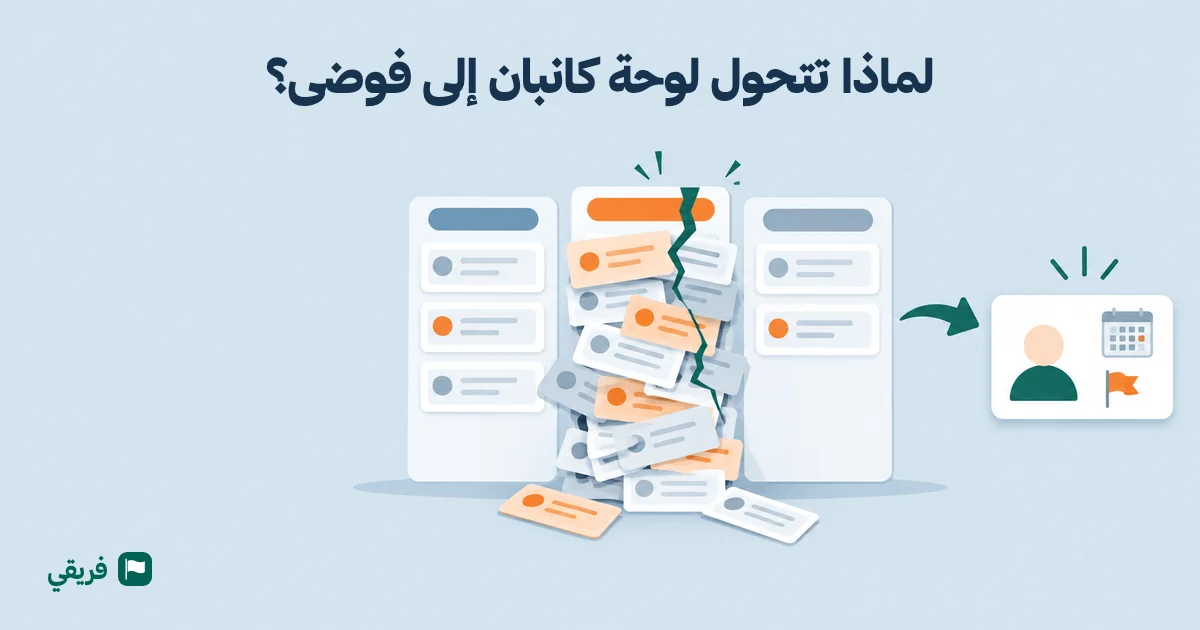
The board started clean
Three months ago, a marketing lead at an agency in Riyadh opened a fresh Trello board. Three tidy columns: "To Do," "In Progress," "Done." A handful of colorful cards. Everything looked under control.
Today that same board has 70 cards, seven columns, and half of them have been stuck in "In Progress" for weeks. Every Monday the team opens it and sees no plan of action, just a wall of sticky notes nobody reads. And the same question runs silently through everyone's head: what exactly am I supposed to do today?
This isn't one agency's story. When you listen to enough teams explain why they stopped relying on task boards, three complaints come up more than any other:
- The board turns into chaos over time
- Moving cards doesn't mean real progress on the project
- Everyone starts a pile of tasks and finishes nothing, everything is "In Progress"
Here's what's striking: none of these three is a flaw in your team. They're the natural result of how the board itself works. So before you go hunting for a better board or a plugin that fixes it, each symptom is worth tracing back to its source, because the fix isn't a cleaner board. It's the question: do you need a board at all?
Problem 1: The board turns into chaos over time
Week one, the board is beautiful. Every card is clear, every column means something. The trouble is that a board doesn't know how to forget.
Cards pile up because no one owns deleting them. "To Do" becomes a graveyard of good intentions: old ideas, tasks that got cancelled but never archived, requests that were handled somewhere else while the card lingered. Then the columns start multiplying: a "Review" column, a "Waiting on Client" column, an "On Hold" column, a "Deferred" column. Each new column was an attempt to organize the mess, and became part of it.
The root cause is simple: the board shows you everything at once, but it never tells you what matters. The layout that felt calm at 15 cards is unreadable at 80. Your eye sweeps the whole wall and catches nothing. Visualization is not clarity. Seeing all the tasks together doesn't mean you know which are yours, which are late, and which deserve your next hour.
Bigger teams try to treat this with rules: archive completed cards weekly, don't create a new column without approval, cap each column at a limit. But those rules are extra overhead: you're now managing the board instead of managing the work. And any tool that needs daily discipline to avoid collapse will eventually collapse. Because teams are busy doing the work, not tidying the board.
The alternative isn't a cleaner board: it's a structure that never accumulates in the first place. When every task belongs to a specific project and has a single owner and a single deadline, a completed task simply disappears from your list into a separate log, without you archiving anything. Only the live work stays in front of you. That's the idea behind the Fareeqy dashboard: one picture of what's actually needed, not a wall of everything that's ever crossed the team.
The result? There's no "weekly board cleanup," because what doesn't pile up needs no cleaning.
Problem 2: Moving cards doesn't mean real progress
This is the most dangerous problem, because it deceives you.
Dragging a card from "To Do" to "In Progress" gives you an instant hit of accomplishment. A tiny motion, but it feels like the project moved. The problem is that nothing actually changed: the design wasn't delivered, the client didn't approve, the page didn't ship. You moved a card from one column to another. That's all.
The board rewards motion, not completion. And that's a real psychological trap. A card can sit in "In Progress" for three weeks looking "active" the entire time, with nothing actually finished. A manager glancing at a crowded board assumes work is flying, when a crowded board can just as easily signal a stall, not productivity.
Real progress on a project isn't measured by how many cards moved. It comes down to two questions:
- How many tasks are actually done?
- Are deadlines being met or slipping?
This is where a tool that displays motion parts ways with one that measures outcomes. When progress is calculated automatically from completed tasks, not from where cards sit, you see the honest picture: this project is 40% done, that one is behind, a third is on time. That's what reports in Fareeqy do: they turn "the team is busy" into "the team finished X and fell behind on Y." Those are two very different things.
Try this test on whatever board you use right now: look at the cards in "In Progress" and ask, for each one, what has changed about the project since this card entered this column? If the answer is "nothing, it just moved," you're staring at motion without progress. And if you want to go deeper on measuring team output with metrics that actually mean something, we wrote a full practical guide on exactly that.
Problem 3: Everyone starts, nobody finishes
Open the board of any struggling team and you'll find its biggest column is "In Progress." That's no accident.
The board puts no cap on how much you start. Nothing stops you from dragging ten cards into "In Progress" in a single day. And that's exactly what happens: every person starts five or six tasks, hops between them, and ends the day having touched everything and finished nothing. The result is a heap of half-done work.
Half-done work is worse than work you never started. It eats your memory ("where did I leave off on this?"), it blocks whoever's waiting on you, and it costs a "reheating" tax every time you come back to it. Switching between tasks isn't productivity: it's a fee you pay from your focus dozens of times a day. Honestly, this is the single habit I've watched wreck small teams' output the most, not because people are lazy, but because the tool never asks them: what are you going to finish today?
Kanban as a methodology actually has a fix for this: the Work-In-Progress limit. Allow only three tasks in progress per person. Great in theory. In practice, the rule needs someone to enforce it, and teams quietly blow past it at the first bit of pressure. A rule that depends on everyone's discipline all the time is a fragile rule.
The simpler alternative: start your day with one question instead of a whole wall. What are the few tasks you'll finish today? Fareeqy has a daily focus list where you pick your handful of tasks for the day from across all your projects, not everything on your plate, just what you'll get done today. That shift from "everything is in front of me" to "this is what I'll finish" is the difference between a team that starts and a team that ships. And if your deeper problem is choosing that handful in the first place, our prioritization guide lays out five proven methods that settle it.
The result? Fewer tasks open at once, and more tasks actually done by the end of the week.
The shared root: the board manages motion, not clarity
Notice that all three problems grow from the same root.
A board is designed to visualize the flow of work across the whole team: where a card starts, where it moves, how many cards sit in each stage. That's a lovely goal for a factory or an assembly line, where a single unit passes through fixed stages. But it doesn't answer the three questions every individual needs each morning:
- What are my tasks?
- When are they due?
- Which one matters most right now?
The board shows you the state of the entire system, while you need clarity about your own role. And because it doesn't answer those questions directly, layers of ceremony get stacked on top: more columns, WIP limits, daily standups to narrate what's on the board. Each new layer is more complexity. And complexity kills adoption, a tool that needs constant training and discipline gets abandoned, and the team drifts back to WhatsApp.
This is where the philosophy splits. The best system for managing work isn't the smartest one: it's the one your team actually uses. And clarity is always cheaper than methodology.
The alternative: clarity over methodology
Let's be honest: Fareeqy doesn't offer "a better Kanban board." Fareeqy chose not to rely on the board at all. A completely different bet, built on one rule:
Every task has one owner, one deadline, and one priority.
No columns to drag cards between, no stages every task must pass through, no WIP limit that needs a cop to enforce it. When you create a task, you answer three questions and nothing more: who owns it, when is it due, and where does it sit in its list? Move it up its list and the whole team sees it comes first. Those three questions kill the ambiguity that generates every problem above. No more "I thought you were doing it," no more "where did that card go?", no more owner-less card floating forever.
Around that rule, the daily experience gets built:
A "My Tasks" page gathers everything assigned to you across every project in one place. You don't open five boards to learn what's on your plate, one list, ordered, and it's yours. More on that in task management.
Ownership is clear by design. Every task carries one person's name, not "the team" and not "In Progress." And three permission levels (team management) make who sees what and who manages what obvious from day one.
Deadlines are part of the task, not a side note. Every task has a due date that shows up in the calendar, Hijri and Gregorian side by side, so you see what's coming due before it slips, not after.
Progress is calculated, not imagined. The dashboard and reports show real completion rates and overdue tasks, because a card that moved isn't an accomplishment, and a completed task is.
These aren't four separate features. They're one product expressing one idea: remove the ambiguity, and you won't need a methodology to manage it. It's also why Arabic-speaking teams have left their Trello boards for Fareeqy, not chasing more features, but more clarity, in an interface that's genuinely Arabic-first.
Board vs. clarity: a direct comparison
| The question | Kanban board (Trello, Asana) | The clarity approach in Fareeqy |
|---|---|---|
| Who owns this task? | Could be an ownerless card, or one with several names | One mandatory owner per task |
| What's the real progress? | A card's position in a column, a misleading signal | A completion rate calculated from finished tasks |
| What do I do right now? | You scan a whole wall and guess | A daily focus list that's yours alone |
| What happens over time? | Cards and columns pile up into chaos | Completed work disappears into a separate log |
| How much discipline does it need? | Archiving rules and WIP limits the team enforces by hand | The structure itself enforces clarity, no rules |
| Learning curve | Grows with every new column and ritual | Three questions per task, and you're done |
Notice the table doesn't say the board is a bad tool. A board is excellent for visualizing a fixed-stage production line. But most teams don't run a production line, they run a group of people, each of whom needs to know what's on their plate today. For that purpose, clarity beats the board. If you want a deeper tool-by-tool comparison, we dedicated a full article to it, and if Trello is your current tool, see the Arabic Trello alternative.
How to climb out of the chaos: 6 practical steps
These work whether you stay on your current tool or switch. The idea is the same: trade motion for clarity.
-
Give every task one owner, by name. Not "the team," not "marketing." One person who can say "yes, this is mine." An ownerless task is a task that won't get done.
-
Give every task one deadline. Even a rough one. A task with no deadline lives in "In Progress" forever, because nothing pushes it toward done.
-
Give every task one priority. When everything is "urgent," nothing is. Decide what actually deserves your next hour. If ranking them is the hard part, the methods in prioritizing tasks settle it.
-
Kill the excess work-in-progress. Don't start a new task before you finish an open one. One completed task is worth more than five stuck halfway.
-
Measure completion, not motion. At the end of the week, ask: how many tasks were finished? Not how many cards moved. Make reports, not a crowded board, your source of truth on the team's state.
-
Start every day with a short focus list. Pick your few tasks for the day before you open anything else. Three tasks you finish beat thirty you stare at.
None of these steps needs a specific tool to begin. But they become automatic when the structure is designed around them from the start, instead of you fighting your tool to force them onto it.
The bottom line: the problem isn't your team
Go back to the three complaints from the top. The board turns to chaos, cards move without progress, everyone starts and nobody finishes. The thread connecting them is that they're all symptoms of one cause: a tool that visualizes motion instead of clarifying roles.
The fix isn't a cleaner board, or another plugin, or one more standup each morning. It's simpler: one owner, one deadline, one priority per task. Remove the ambiguity and most of what you thought was a problem in your team disappears.
If you want the bigger picture on organizing your team's work from the ground up, start with the complete guide to project management. And if you're ready to try the idea in practice, Fareeqy's free plan is enough to feel the difference yourself, no credit card, and no board to clean up every week.
Fareeqy, because teamwork doesn't have to be complicated.